Musings on Digital Identity

Category: Claims

U-Prove Specifications Licensed and Sample Code Released

U-Prove logoThis morning at the RSA conference, Scott Charney announced that Microsoft has licensed the U-Prove technology under the Open Specification Promise and released sample implementations in C# and Java under the BSD license. Implementers will be interested in two specifications: the “U-Prove Cryptographic Specification V1.0”, which documents U-Prove’s cryptographic operations, and “U-Prove Technology Integration into the Identity Metasystem V1.0”, which documents how to use U-Prove tokens with WS-Trust. These specifications are intended to enable interoperable implementations.

The U-Prove technologies enable two key properties: minimal disclosure and unlinkability. For more about U-Prove and today’s Community Technology Preview (CTP) release, see the Microsoft U-Prove site, the post announcing the release, and Vittorio’s post (with links to videos).

Updated Federated Identity Product Releases

Today Microsoft announced the availability of new releases of several identity products: Active Directory Federation Services (AD FS) 2.0, the Windows Identity Foundation, and CardSpace 2 (which collectively were formerly referred to as “Geneva“), as well as Federation Extensions for SharePoint. See Announcing the AD FS 2.0 Release Candidate and More and Announcing WIF support for Windows Server 2003 for the release announcements as well as links to numerous step-by-step guides, samples, docs, and video. Thanks to all those who did interop work with us (including at Catalyst, Liberty, and pair-wise) to help ensure that these releases will work well with other’s implementations.

OpenID v.Next Goals

OpenID logoThe OpenID v.Next session at IIW run by David Recordon and Dick Hardt reached some important conclusions about the future of OpenID. The motivation for the v.Next discussion was the sense that we’ve learned enough since the OpenID 2.0 specification was finalized that it’s time to revise the spec to incorporate what we’ve learned. This session attempted to reach a consensus on the priorities for the next version of OpenID, with a large number of the important players participating. I haven’t seen the decisions made published elsewhere, so I’m recording them here.

David organized the session around a stated goal of producing an evolved OpenID specification within the next six months. The consensus goals reached were as follows. The numbers represent the number of participants who said that they would work on that feature in the next six months.

  • Integrating the UX extension (in which the user interacts with the OP in a pop-up window) into the core specification: 12
  • Evolving the discovery specification for OpenID, including adding OpenIDs using e-mail address syntax: 10
  • Integrating attributes (claims) into the core specification: 9
  • Integrating the OAuth Hybrid specification into the core specification: 8
  • Supporting an optional active client (identity selector) and non-browser applications: 8
  • Improve security, including investigating enabling use at levels of assurance above NIST level 1: 8
  • Better support for mobile devices: 8
  • Addressing the problem of long URLs (where browsers limit URL length to 2048 or sometimes 256 characters): 6

And in case it isn’t obvious from reading the above, there was also an explicit consensus in the room that OpenID v.Next would not be backwards compatible with OpenID 2.0. (It will be related to, but not compatible with OpenID 2.0, analogously to how SAML 2.0 is related to, but not compatible with SAML 1.1.) I believe we have interesting and exciting times ahead!

Thanks to Hannes Tschofenig for publishing photos of the whiteboard and some of the votes.

Interoperable Verified Identity Claims Progress

Many of us share a vision of an Internet where people can have authorities that they trust make verified claims about themselves in contexts that they choose. For instance, using an identity that can issue “age-18-or-over” or “age-21-or-over” claims for me may enable me to utilize services at a site accepting those claims from that issuer that might otherwise be closed to me. More specialized interoperable verified claims, such as “coppa-certified-adult”, are also possible, and may open other doors for me. Before another month goes by, I wanted to draw attention to two new Information Cards that have been issued that represent progress in making this vision for interoperable verified claims a reality.

Privo CardPrivacy Vaults Online (a.k.a. Privo) launched a Privo parent card that can make the claim that the person has been certified as an adult using a method that satisfies the US COPPA regulations. Indeed, this is the “coppa-certified-adult” claim referenced above, and is defined in the ICF Claims Catalog so that others can use it as well. The Privo card also broke new ground in utilizing a “verification-method” claim, so that the relying party can tell how the information was verified, and the “verified-claims” method, so the relying party can tell which claims were verified. It also offers the same “age-18-or-over” claim that the Equifax card does. See the press release for more information, including sites where you can use your Privo card.

Acxiom CardAcxiom issued the Acxiom Identity Card, which a person can use to make verified name and address claims about them self online. It also makes a new ICF-defined claim “icam-assurance-level-1” asserting that “the security token is issued according to the requirements of the U.S. federal Identity Credential and Access Management (ICAM) Assurance Level 1”. See the press release for more information about the Acxiom card.

“Geneva” Beta 2 is Here

Microsoft announced the availability of the second beta of its forthcoming “Geneva” claims-based identity software today during Tech•Ed. This is a significant milestone for the team along the path to releasing production versions of the “Geneva” software family, which includes the server, framework, and CardSpace. I’m personally particularly proud of all the interop work that has been done in preparation for this release. I believe that you’ll find it to be high-quality and interoperable with others’ identity software using WS-*, SAML 2.0, and Information Cards.

For more details, see What’s New in Beta 2 on the “Geneva” Team Blog. Visit the “Geneva” information page. Check out the Identity Developer Training Kit. Learn from team experts on the ID Element show. Download the beta. And let us know how it works for you, so the final versions can be even better.

Enjoy!

Equifax, the Information Card Foundation, and Interoperable Verified Claims

Equifax Verified Over 18 CardMy congratulations to Equifax for issuing the first commercially deployed Information Cards with verified claims. This is huge step forward towards a future where individuals can routinely make verified digital statements about themselves, facilitating trusted, privacy-preserving interactions online.

I’m writing to bring you some of the story-behind-the-story in Information Card Foundation member Equifax issuing these verified Information Cards. Rather than use proprietary claims schemas in their cards, Equifax chose to use claims that are designed to be interoperable with cards that will be issued by other identity providers. Their cards use a combination of the standard Information Card claims, along with a newly defined age-18-or-over claim that anyone can implement.

This new age-18-or-over claim is the first to emerge from the new Information Card Foundation Identity Schemas Working Group. This is a place where anyone can propose a new claim URI and register it for use by all. You will find the age-18-or-over claim definition in the working group’s Claims Catalog. This is an example of how the Information Card Foundation is facilitating collaboration to advance interoperable Information Cards.

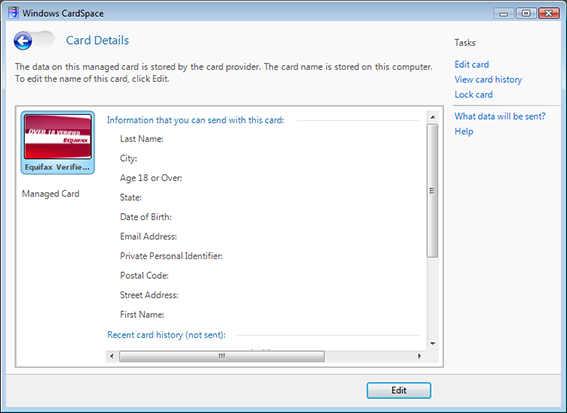
I’ll close by saying that while the Equifax page promotes the new Azigo identity selector, their card uses interoperable protocols and file formats, and is compatible with all identity selectors. For instance, you’ll see a screen shot of my Equifax card in Windows CardSpace below, showing both the use some of the standard Information Card claims, as well as the new age-18-or-over claim from the ICF Claims Catalog.

Equifax Age 18 or Over Card Details

More News from the PDC: Beta Releases of “Geneva” Platform Components

As just announced on the “Geneva” Team Blog (formerly known as the CardSpace Team Blog), beta releases of all three components of Microsoft’s “Geneva” identity platform are now available at the “Geneva” Connect site. The components are:

  • “Geneva” Framework: Previously called “Zermatt“, the Geneva Framework helps developers build claims-aware .NET applications that externalize user authentication from the application and helps them build custom Security Token Services (STSs). It supports WS-Federation, WS-Trust, and SAML 2.0.
  • “Geneva” Server: Geneva Server is an STS that issues and transforms security tokens and claims, manages user access, and enables easy federation. Based on the “Geneva” framework, it also supports WS-Federation, WS-Trust, and SAML 2.0.
  • Windows CardSpace “Geneva”: CardSpace “Geneva” will be the next version of Windows CardSpace. It has a much smaller download footprint, starts fast, and has some innovative user interface improvements made in response to feedback from the first version.

All are early betas that are works in progress, but I highly encourage those of you who are interested in claims-based identity to download them and let us know what you think. Also, be sure to check out the “Introducing ‘Geneva’” whitepaper by David Chappell.

Digital Identity Podcast for MySuccessGateway

MicrophoneKim Cameron and I recorded a podcast on digital identity for MySuccessGateway this week at the invitation of Jim Peake of SpeechRep Consulting. Jim was a gracious, informed, and enthusiastic host during our conversation, which covered a wide range of digital identity topics including identity theft, shared secrets, privacy, Information Cards and the Information Card Foundation, the value of verified claims, business models for identity providers, password fatigue, defeating phishing attacks, OpenID, why interoperability is essential and the interoperability testing the industry is doing together to make it a reality, some of the identity products that are shipping and forthcoming, and the Laws of Identity. He even asked us how we felt about Bill Gates’ retirement, as a kicker.

If that sounds interesting to you, give it a listen

First Verified Age Information Cards

IDology Verified Over 18 cardLast week IDology demonstrated a first that many of us see great possibilities for: an Information Card making a verified age claim. I’m excited at this first step towards the goal of enabling people to routinely use interoperable verified claims about themselves via Information Cards.

Obtaining my age-verified card online was easy. I submitted my name, address, and birth date (via a self-issued card) to IDology’s verification process. Next they asked me a few additional questions to confirm that I was likely to be the person who I claimed to be. With correct answers in hand, they proceeded to issue me an Information Card enabling me to make IDology-verified claims on my own behalf.

I used the card at two (demo) relying parties: a social networking site that restricts membership to people 18 and over and an online wine store. You can also imagine verified identity information being valuable at job and career sites, at dating sites, when applying for insurance or credit, for enrolling in promotions, etc. The possibilities are endless.

Please join me in congratulating IDology on this significant achievement. I believe it will be the first of many good things to come in the verified identity space!


The remainder of this post shows the process of obtaining and using my verified identity Information Card. In some cases I intentionally went through extra steps, such as previewing the cards before sending them, to make it completely clear what is occurring. The address of the demo site is obscured at IDology’s request because this is not yet a production service. Some of the (real) data about me used to obtain the card is obscured for privacy reasons.

Signing Up for a Verified Age Card

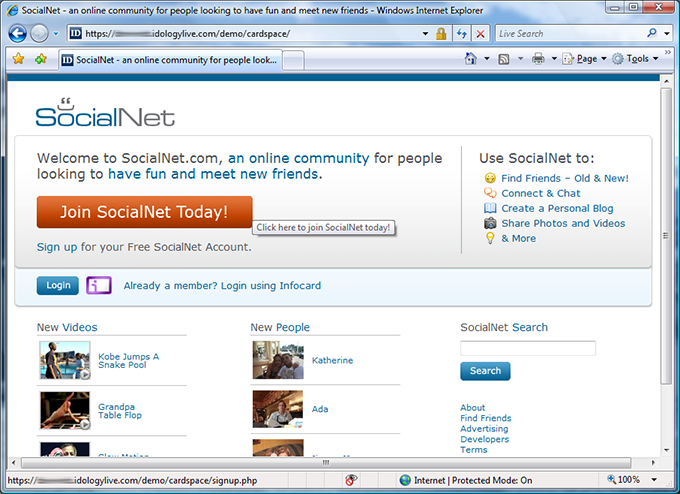
SocialNet start page

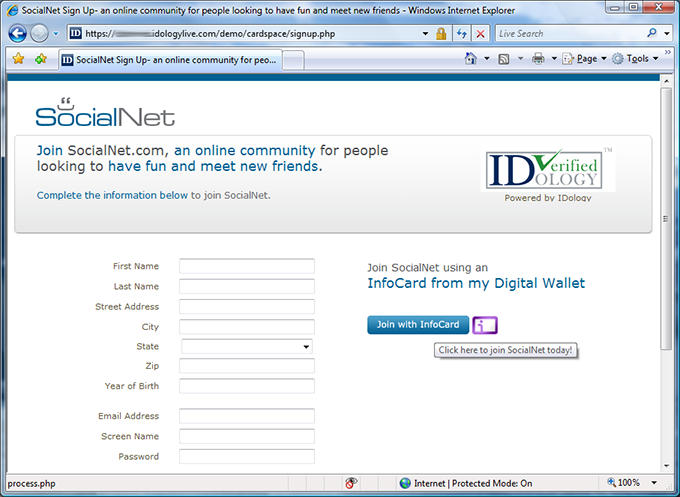
The experience starts by visiting the “SocialNet” site, which invites me to join. I click “Join SocialNet Today”.

SocialNet join page

SocialNet lets me join either by typing my information into a web form or by providing it via an Information Card. I click the Information Card icon.

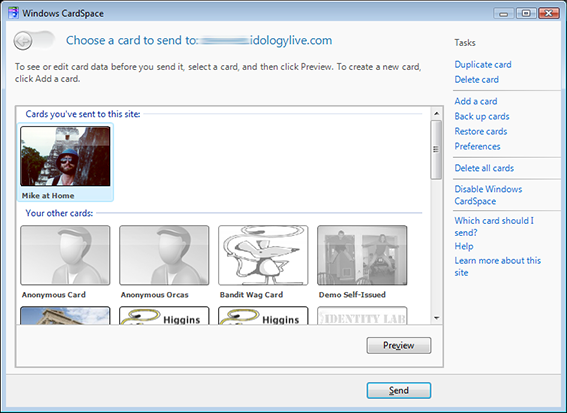
SocialNet join card selection

This brings up CardSpace, where I choose a self-issued card with my home address.

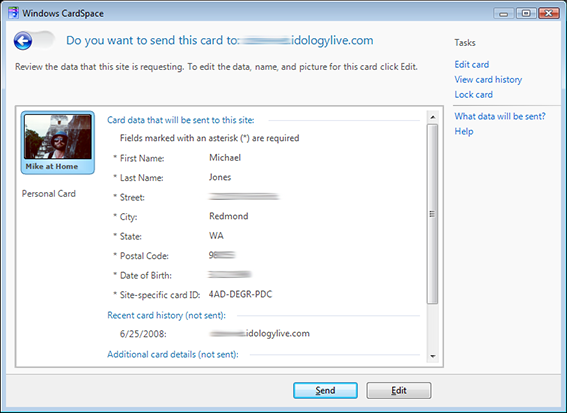
SocialNet join card preview

I preview the card, seeing that the site will be sent my name, address, and birth date. I click “Send”.

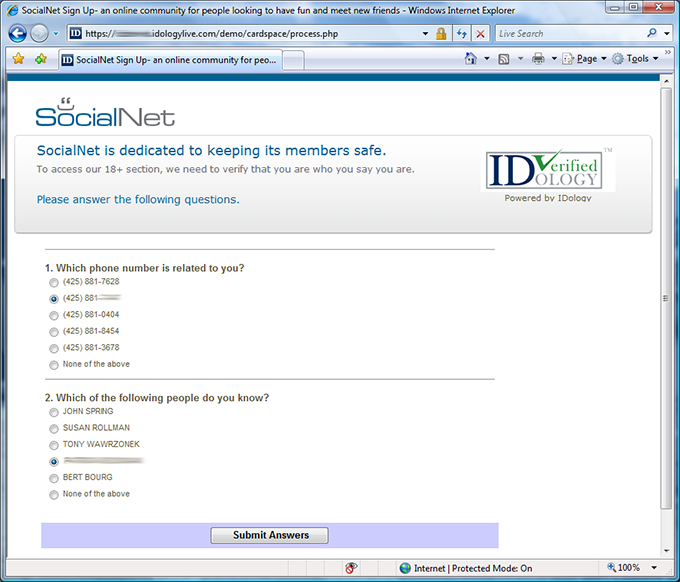
SocialNet verification questions

I’m asked two questions that I should know the answers to to help confirm that I am who I say I am. I answer them correctly.

SocialNet joined

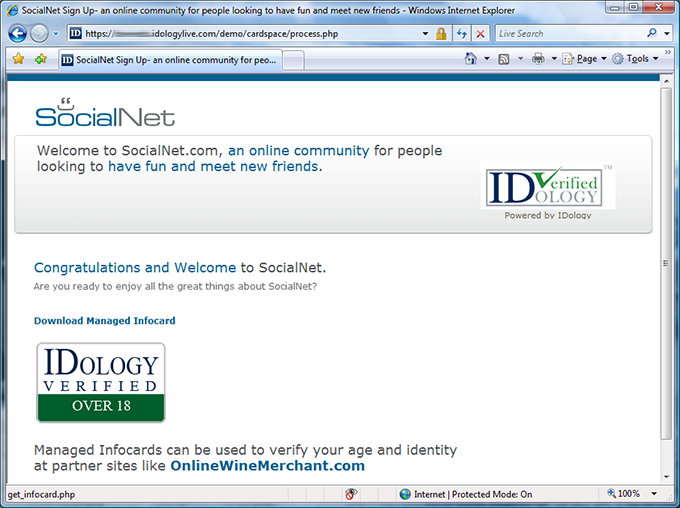
Having passed the identity verification process, I’m given the opportunity to download an Information Card for my newly verified identity. I click on “Download Managed InfoCard”.

Install IDology card

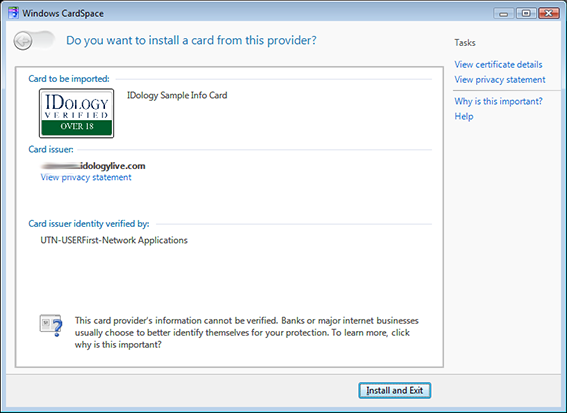
I click the “Install and Exit” button to install my verified identity Information Card.

Using the Card at SocialNet

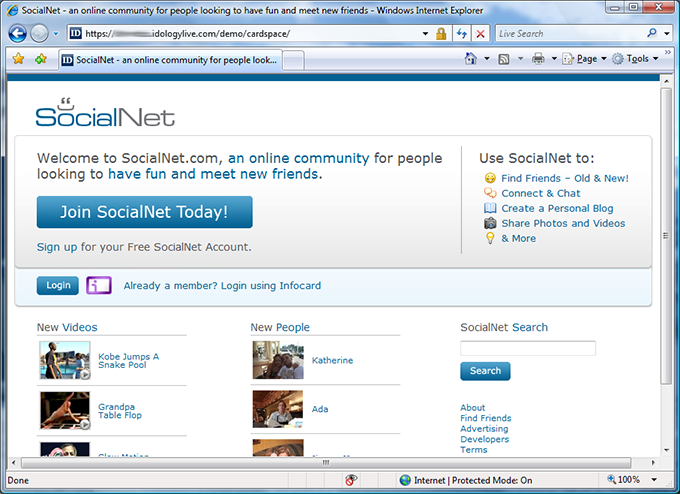
SocialNet login page

Now that I have a verified age card, I use it to sign in at SocialNet by clicking on the Information Card icon.

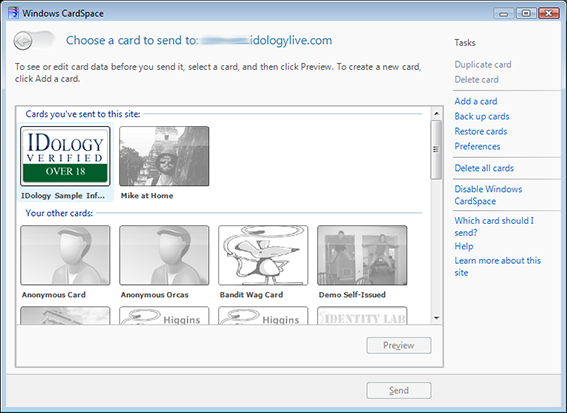
SocialNet login card selection

I choose my IDology verified Information Card and click “Preview” to review the claims I’m being asked for.

SocialNet login card preview

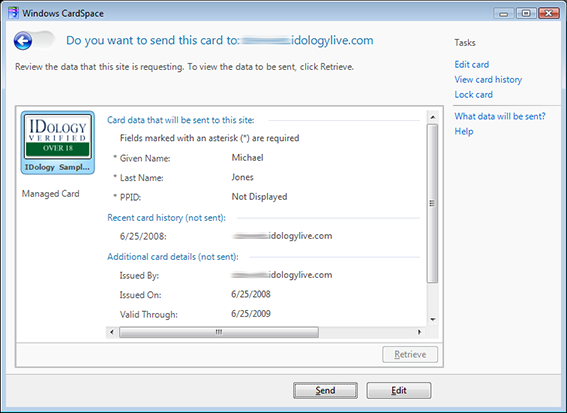
SocialNet is only asking for my name and the PPID for my card. I send them.

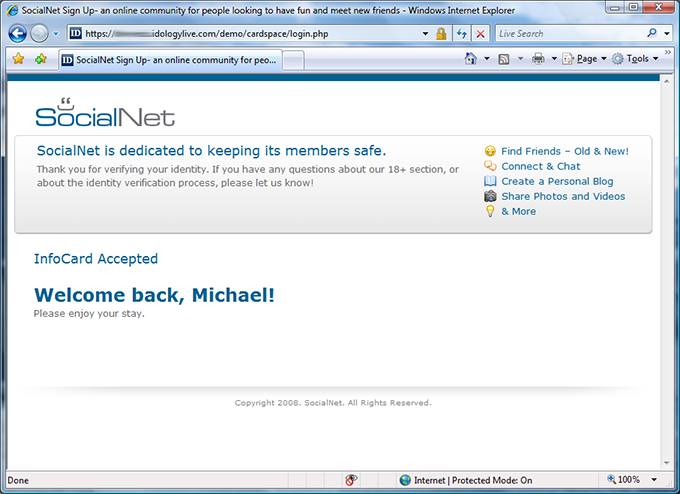
SocialNet logged in

I’m logged into SocialNet using my verified Information Card.

Using the Card at OnlineWineMerchant.com

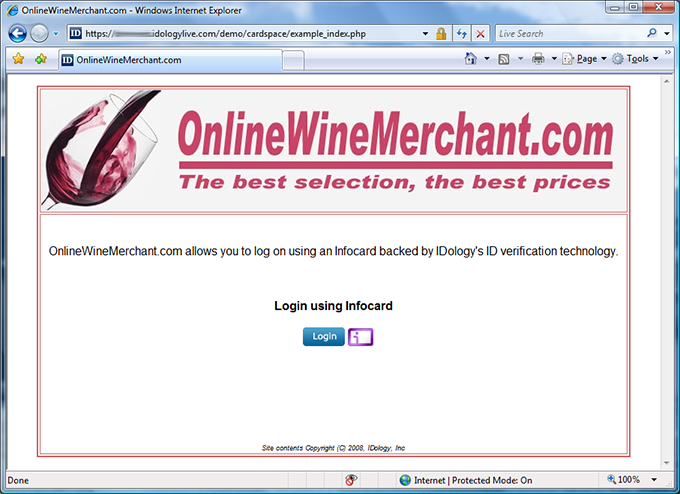
OnlineWineMerchant login page

Now I go to another site that accepts my verified age Information Card: “OnlineWineMerchant.com”. I click the Information Card icon to sign in.

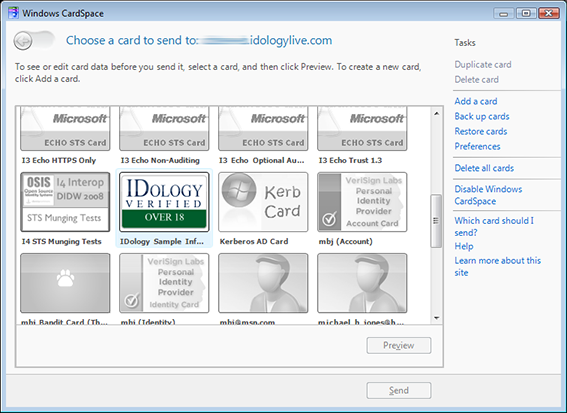
OnlineWineMerchant login card selection

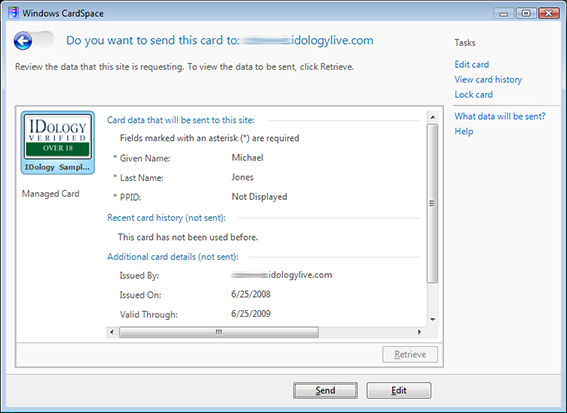
My IDology verified Information Card is accepted by the site. I choose it and click “Preview”.

OnlineWineMerchant login card preview

OnlineWineMerchant.com is also only asking for my name and a PPID. (In a real deployment, I suspect it would be asking for an age claim of some kind too.) I send the card.

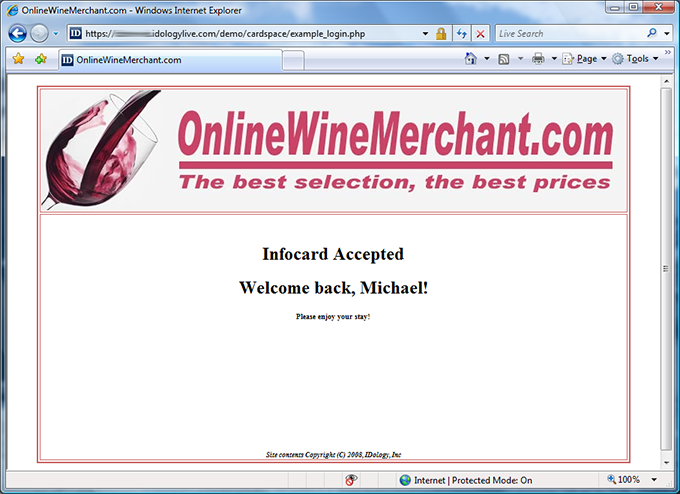
OnlineWineMerchant logged in

I’m logged into OnlineWineMerchant.com using my verified age card, letting me take advantage of the verification I did for SocialNet on this site too. This is the synergy that will make Information Cards with verified identity claims a valuable addition to the identity landscape.

The History of Tomorrow’s Internet

Ryan JanssenI recently encountered Ryan Janssen‘s insightful series entitled “The History of Tomorrow’s Internet” and immediately read the whole thing in one sitting. Among other gems, I found in it the clearest explanation of the value and promise of XRI/XDI that I’ve ever read. Great stuff!

The most recent installment detailed his experiences of “how it feels for a regular person to use Cardspace”. In particular, he documented his experience of using CardSpace for the first time to leave a comment on this blog. He introduced his narrative with:

… as someone who’s business it is to build great software, I KNOW how hard good UI is. Believe me, I work with a GREAT product team and we try REALLY hard to make intuitive software and we fail EVERY day. Having said that, this post isn’t going to paint a real pretty picture.

I’ll let each of you read his blow-by-blow narrative yourself. He closes with:

So what’s the final analysis? Well, as I stated in the beginning, the purpose of this post isn’t to bash Microsoft or Cardspace. Like I said, I build software and when I actually see a normal person use it for the first time, I’m inevitably embarrassed at how difficult it is. Software is hard and Cardspace is brand new. Nonetheless, this does show how far the technology has to go before Mom and Dad are going to be using it. Usernames and Passwords are UBIQUITOUS. We’ve been trained on the visual metaphors for at least a decade. Replacing that with ANY other paradigm is going to rough. To have any chance of success, the Cardspace workflow will need to be much improved.

Because I’m a member of the CardSpace team, I can say that as much as the team is understandably proud of what they accomplished in V1, they’re also pragmatic realists who are fully aware of the issues that Ryan documents so well and the vital importance of addressing them in our future releases. It’s exciting participating in that very process on the fifth floor of Microsoft building 40, day in, day out, as the team defines and refines what the next release will contain. Greatly improved usability is certainly one of our highest-priority goals.

I know that Ryan has also motivated Pamela and me to take a look at how the flow on the blog can be improved. PamelaWare for WordPress isn’t even yet a V1 release (it’s at v0.9 currently) and I know Pamela has lots of ideas on how to improve it. Ryan’s experiences will certainly help inform the next release.

Also, I’ll remark on these excellent observations:

Ready to post? Not yet. Since my iCard is self-issued, Mike’s site (yes, the site is called self-issued.info ironically enough) doesn’t trust me and has now decided that I need to verify my email address. This is obviously a little annoying, but it brings up a good use-case for the first Claim Provider–one that has verified my email address, home address, and phone numbers, so I NEVER have to respond to an email or text message like this again.

Asking the user to verify his or her e-mail address is a way of obtaining a backup means of authentication that can be used in the case where user has lost his Information Card. Just like many accounts backed by passwords use e-mail in the “lost password” flow, PamelaWare uses e-mail to the user in the “lost card” flow and verifies ownership of the e-mail address at account creation time. Ryan correctly points out that if I had received a verified e-mail address as a claim there’s several steps we could have skipped. Making this scenario a reality is one of my personal goals for the Identity Layer we’re all building together.

There’s nothing like real user data to inform what needs to happen next. Thanks, Ryan, for taking the time to provide it to all of us. I look forward to reading the next installment of the series!

Welcoming Credentica’s People and Privacy Technology to Microsoft

Stefan BrandsI’m writing today to publicly welcome Stefan Brands, Christian Paquin, and Greg Thompson, of Credentica to Microsoft’s Identity and Access Group. I’m looking forward to working with them and to us adding their fantastic minimal disclosure technology to our identity products. Like Kim, I’m excited!

I urge people to check out Stefan’s announcement, Kim’s detailed write-up about the significance of this technology (I love the phrase “Need-to-Know Internet”), and Brendon Lynch’s post on Microsoft’s Data Privacy blog.

Welcome to Microsoft!

Unverified Claims

Which would you trust more? Self-issued claims or unverified claims?

Read Marc Goodner’s new blog and decide for yourself. ;-)

Interoperable Verified Identity Claims

Monday morning before the Internet Identity Workshop people representing both providers of verified identity attributes and some of the key Information Card software projects met to talk about interoperable ways of exchanging verified identity claims via Information Cards. Verified claims are made by third party identity provider on your behalf, and have been validated in some fashion by the identity provider.

For instance, while I might claim that my street address is 123 Main Street, a statement by an authoritative data source on my behalf that they have verified that my address is 123 Main Street is substantially more valuable and may be required by relying parties for some purposes.

While the statement “I have verified the subject’s address as being 123 Main Street” is expressible in innumerable ways, the participants expressed a shared interest in expressing it the same way. That way Information Cards making this statement by different identity providers will interoperate, giving relying parties a choice of verified identity providers, which is good for everyone. The high-order bit coming out of this discussion is that we all agreed to agree.

The primary problem we tackled together was how to represent verified versions of the claims expressible in self-issued Information Cards like Name, Address, E-mail address, Gender, Date of Birth, etc. The constraints on the solution we agreed to were:

  • Compatibility with self-issued cards: Cards capable of issuing verified claims should also be accepted by relying parties willing to accept unverified versions of these claims.
  • Verification of individual claims: It should be possible to issue tokens in which some claims are verified and others are not.
  • Compatibility with CardSpace V1: The method for expressing verified identity claims should be usable from the first release of Windows CardSpace, as well as other compatible identity selectors such as the Higgins and Bandit selectors.

The solution we whiteboarded out together has the following properties:

  • Identity providers should advertise the ability to provide claims corresponding to the standard self-issued set under the standard schema URIs for self-issued cards, such as http://schemas.xmlsoap.org/ws/2005/05/identity/claims/streetaddress, even if a verified form of the claim is available. This satisfies the “compatibility with self-issued cards” requirement.
  • Identity providers will use a SAML 1.0 token for expressing verified identity claims intended to be compatible with self-issued information cards.
  • Identity providers will use common URIs for advertising and providing the verified versions of the claims in the self-issued claims schema. For the verified versions of the claims rooted at http://schemas.xmlsoap.org/ws/2005/05/identity/claims/ we discussed a strawman proposal of rooting the corresponding verified version under http://schemas.xmlsoap.org/ws/2005/05/identity/claims/verified/. For instance, the URI for a verified street address claim would be http://schemas.xmlsoap.org/ws/2005/05/identity/claims/verified/streetaddress.

Of course, agreeing to common URIs for advertising and requesting verified claims is only the first step. Interoperability also requires that the structure of the verified claim values be compatible.

Verified claims, as currently issued by data providers through existing channels, are structured records containing both the data values as well as statements about the data. When provided via Information Cards, this will still be true.

Guided by input from the participating data providers, we whiteboarded the following proposal for how to structure these values:

  • Each verified claim value will be represented as a standard XML structure with a required subfield, optional standard subfields, and optional extension subfields that can be defined by identity providers.
  • The required subfield is the “value” field, providing the verified value of the claim.
  • Optional interoperable subfields discussed were:
    • who: What party verified the claim.
    • how: How the claim was verified.
    • when: When the claim was verified.
    • expires: When the verification should be treated as having expired.
    • supplied: The value supplied as input to the verification, which may differ from the “value” field. For instance, while the verified value of my given name might be “Michael”, the supplied value might be “Mike”.

For example, in response to a relying party’s request for the claim http://schemas.xmlsoap.org/ws/2005/05/identity/claims/verified/givenname a response might be:

<verified>
  <value>Michael</value>
  <who>Acme Data Provider</who>
  <when>2007-05-14T16:30:00Z</when>
</verified>

Of course, defining fields like these begs the question “what data types do these fields use?” In response, a proposal was made to consider making this explicit by allowing (or requiring) that a type URI be provided for each such element, thus making the fields self-describing.

One possibility is to add a “type” attribute to these fields to provide this information. Here’s an example illustrating this approach:

<verified>
  <value type="http://schemas.xmlsoap.org/ws/2005/05/identity/claims/givenname">Michael</value>
  <who type="http://www.w3.org/2001/XMLSchema#string">Acme Data Provider</who>
  <when type="http://www.ietf.org/rfc/rfc3339.txt">2007-05-14T16:30:00Z</when>
</verified>

Beyond the self-issued claim types
Of course, the vast majority of verified claims will not correspond to the self-issued card claim types. Many will be specific to particular application domains. There was agreement that wherever possible, existing schemas should be used. For instance, in the employment space, HR-XML schemas might be utilized.

Another issue raised was that some kinds of verified claims will themselves be complex data structures, such as “employment history”, “education”, or “professional certifications”. While the display token value for these claims should try to communicate something of value, such as an indication of the most recent job or degree, it was recognized that the person may have to go directly to the identity provider to view these claims in full detail.

Next Steps
It is our hope that this discussion will lead to experts defining precise representations for these and other useful interoperable claims. The parties involved in these discussions all want to see this happen soon so that identity providers and relying parties can start to take advantage of interoperable verified claims through Information Cards as soon as possible.

Caveats and Closing
The examples above are illustrative, not normative. They’re intended to document the discussion we had and provoke further discussion. I’m sure there are numerous ways that they can be improved and useful approaches that we didn’t even think of. Please join in!

Discussion participants were:

John Cartin, BackgroundChecks.com
Pat Mangiacotti, BackgroundChecks.com
Tony Nadalin, IBM / Higgins Project
Dieter Sommer, IBM / Higgins Project / Idemix
John Dancu, IDology
Mike Jones, Microsoft / CardSpace
Andy Hodgkinson, Novell / Bandit Project / Higgins Project
Paul Antoniades, ooTao
Barry Beechinor, ooTao
Andy Dale, ooTao
Mary Ruddy, Social Physics / Higgins Project
Dick Hardt, Sxip Identity
Brian Hernacki, Symantec
Bill Johnson, Symantec
David Recordon, VeriSign
Andrew Jaquith, Yankee Group

Thanks all for a lively and productive discussion!

Page 13 of 13

Powered by WordPress & Theme by Anders Norén