
Musings on Digital Identity

Category: OpenID

User-Centric Identity Interop at Catalyst

OSIS Logos

I’ve been waiting to write about the user-centric identity interop at the Burton Group Catalyst conference until the Burton Group report about the event was published. Now it’s here!

At the interop we demonstrated interoperability between 7 Identity Selectors, 11 Identity Providers, and 25 Relying Parties. As Bob Blakley wrote:

The interop event was a milestone in the maturation of user-centric identity technology. Prior to the event, there were some specifications, one commercial product, and a number of open-source projects. After the event, it can accurately be said that there is a running identity metasystem.

The full report includes a list of participants and the software they brought to the table, an overview of the results achieved, as well as the issues identified through the interop. See Bob’s post for all the details!

The report also includes thank-yous, to which I’d like to make some additions: Thanks are due to Jamie Lewis, Gerry Gebel, and Bob Blakley of the Burton Group for sharing our vision for this interop, striving to make it the best that it could be, and tirelessly working the details until it came true. You truly helped the industry to come together in a valuable and significant way.

Also, while I appreciate Bob’s thanks for the work I put into the Open Specification Promise, there were many believers in and drivers of this important work at Microsoft besides myself, both from the Law and Corporate Affairs team and from the Federated Identity product group. This was truly a team effort.

I’m also happy to report that there will be a follow-on interop in Europe at the Catalyst conference in Barcelona, October 22-25, which will hopefully include even more participants and scenarios, including more multi-protocol interoperation proof points. Hope to see you there!
Information Cards at OpenID Providers

PIP InfoCardsThis week VeriSign upgraded their Personal Identity Provider (PIP) to support Information Cards. As David Recordon wrote at VeriSign’s official “Infrablog”:

Last Saturday, we completed the upgrade of our Personal Identity Provider. All accounts have been automatically upgraded and the URL is the same at http://pip.verisignlabs.com. We definitely encourage everyone to come try it out as we believe it is the best OpenID Provider in existence! Not only does it have all of the features from the PIP we launched last May, but adds support for OpenID 2.0, the ability to manage multiple identities within one PIP account, integration with strong authentication via our VeriSign Identity Protection network, Information Card support as one way to help protect against phishing attacks, and our SeatBelt Firefox add-on which works with a variety of OpenID Providers.

PIP supports Information Cards in two ways:

  • Logging into your PIP account: You can use a managed Information Card to log into your PIP account, providing a phishing-resistant alternative to logging in with a username and password typed into the browser.
  • Using your PIP Identities at other sites: PIP issues managed Information Cards for each of your PIP identities, which you can use to sign into sites using Information Cards for login and/or account creation. (And of course, these same identities are also OpenIDs as well.)

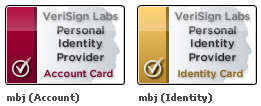
Images of my PIP cards for these two use cases are shown at the top of this post. I can now use my PIP account card to sign into my PIP account and my PIP identity card to sign into other sites. PIP is doubly cool because I believe it’s also the first general-purpose identity provider to be secured by an Extended Validation Certificate (see the green color of the IE7 address bar?). Great progress!

SignOn.com LogoThis follows on last month’s launch of Ping Identity’s SignOn.com identity provider. SignOn.com lets you log into your OpenID account using a self-issued Information Card — a convenient, password-free, and phishing-resistant authentication mechanism.

Both are fantastic steps towards our shared goal of building a convenient, secure, ubiquitous identity layer for the Internet. Expect to see lots more developments like this soon!

Yours truly,
mbj.pip.verisignlabs.com and mbj.signon.com

Congratulations to David Recordon

David RecordonLet me second Scott Kveton‘s congratulations to David Recordon for winning this year’s Google-O’Reilly Open Source award for Best Strategist. As Scott wrote:

Tonight, David Recordon of Verisign won Google’s prestigious “Best Strategist” open source award for his work on OpenID.

I’ve known David for a little over a year and have been amazed at hist ability to help shape the technology and community that makes up OpenID (all this before the ripe old age of 21 … no congratulatory beers for you David!).

I first met David during a meeting at Six Apart (long, long ago) with he and Brad (the creator of OpenID) when we all cooked up the OpenID Bounty program. I was a newbie in the OpenID world and David was great at helping me as I found my way.

David has been tireless in his work on OpenID being “the face” of the community and spending more time on the road than anybody I’ve ever seen (c’mon, the guy is already a United uber frequent flyer) showing up at every conference you can think of across the entire globe. He has been instrumental in seeding small user communities across the globe with his passion for making OpenID the technology it has become.

David, you have a fantastic future ahead of you … congrats, the best is yet to come.

I’ve also greatly enjoyed working with David on advancing digital identity together over the past year and value his energy, judgment, and fun-loving spirit. I’ll see you out there on the Identity road, David… Congratulations again!

Phishing-Resistant Authentication Specification Ready

David Recordon just posted a simple draft OpenID specification enabling OpenID relying parties to request that a phishing-resistant authentication method be used by the OpenID provider and for providers to inform relying parties whether a phishing-resistant authentication method, such as Windows CardSpace, was used. This is a major step forward in fulfilling the promise of the JanRain/Microsoft/Sxip Identity/VeriSign OpenID/Windows CardSpace collaboration announcement introduced by Bill Gates and Craig Mundie at the RSA Security Conference this year.

In his post “Bringing Useful Scalable Security to OpenID” David wrote:

The integration cost of OpenID as a Relying Party is extremely low, the technology is free and as Brian Ellin and I showed at Web 2.0 Expo the time commitment is also low due to a lot of great Open Source code out there which takes care of the heavy lifting. So now the RP has successfully integrated OpenID and removed the need for new users to create yet another password for their site, though they no longer have the control over the strength of a user’s authentication process. The RP may be a simple Web 2.0 site and not care beyond that the user has a password, it may store marginally sensitive information and want to make sure that the Provider did something to help protect the user from common phishing attacks, or maybe it’s a site which has truly sensitive information and wants to make sure that a second-factor device, such as a VIP token, was used.

With the OpenID Provider Authentication Policy Extension that I just published, this is now possible. This extension to OpenID 1.1 and 2.0 allows Relying Parties to express preferences around the authentication, such as “use technology which is phishing resistant” (stemming from the collaboration announcement at the RSA conference earlier in the year), for the Provider to inform the user of the request, guide them through the authentication process, and then inform the Relying Party what happened. By taking advantage of existing specifications from the likes of the National Institute of Standards and Technology (NIST), Providers can also convey information as to the strength of a password or combination of a password and digital certificate or hardware device used. While the high-end of the specification may be beyond the uses of OpenID today, it certainly fulfills the scalable security vision that we have. Through this specification not only can I now strongly protect my OpenID identity, but let others know that I’m doing so and truly take advantage of a reduction in credentials needed when browsing the web.

I can’t wait to use the implementations that are sure to follow shortly!

Page 12 of 12

Powered by WordPress & Theme by Anders Norén