Musings on Digital Identity

Category: OpenID Page 11 of 12

Identity Choice at HealthVault

OpenID logoSean Nolan, chief architect of Microsoft’s HealthVault service, posted an article about giving their users choice for the identities they use to access their information. He announced that in addition to accepting LiveIDs, HealthVault is about to start accepting OpenIDs from two OpenID Providers and is also building native Information Card support. As Sean wrote:

As we’ve always said, HealthVault is about consumer control — empowering individuals with tools that let them choose how to share and safeguard their personal health information. OpenID support is a natural fit for this approach, because it allows users to choose the “locksmith” that they are most comfortable with.

You can certainly expect to see more such options in the future. For example, we are in the process of building in native support for Information Cards, which provide some unique advantages, in particular around foiling phishing attempts.

Talking about OpenID, Sean also wrote:

As we learn more, and as OpenID continues to mature, we fully expect to broaden the set of providers that work with HealthVault. We believe that a critical part of that expansion is the formalization and adoption of PAPE, which gives relying parties a richer set of tools to determine if they are comfortable with the policies of an identity provider.

Please join me in congratulating the HealthVault team on being the first Microsoft service to employ OpenID and for their commitment to providing their users convenient, secure access to their healthcare data.

Even Phishers Have Their Problems

While gone phishing, I discovered that the use of JavaScript puts one barrier up that phishers have to overcome to impersonate a legitimate site. In a characteristically hilarious post, Paul Madsen points out that, besides having to overcome active defenses like Sxipper (“Down girl!”), phishers may also inadvertently present pages localized for their locale, rather than the victim’s.

Intrepid identity adventurer though Paul may be, this stopped him dead in his tracks:

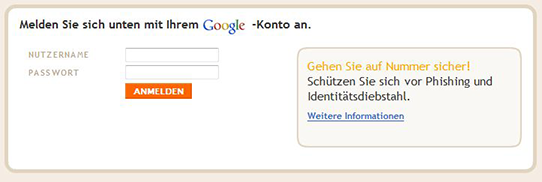
Deutsche Blogger login

Of course, maybe Paul’s German was better than he thought, as the page was urging him to “Gehen Sie auf Nummer sicher! Schützen Sie sich von Phishing und Identitätsdiebstahl.” — “Go safe! Protect yourself from phishing and identity theft.” :-)

Gone Phishing

Fun Communications‘ site idtheft.fun.de lets you mount your very own man-in-the-middle based phishing attack against the OpenID provider of your choosing. Rather than redirecting you to the OpenID provider you specify, it instead redirects you to a page impersonating the OpenID provider, created using content scraped from the real site behind the scenes.

This is the same kind of attack shown in Kim’s phishing video. idtheft.fun.de lets you have the fun of doing it yourself!

I tried it myself with several OpenID providers I use. Predictably, I was typically able to “steal” the passwords for OpenIDs when logging into them with passwords and hijack the resulting logged-in sessions. “Protecting” an account with a one-time-password (OTP) device did nothing to stop this; my “attack” still succeeded in hijacking the session established using a password in combination with an OTP value.

Two things did defeat these attacks. Because Information Cards generate site-specific sign-in information and the attacker’s site is different than the authentic site, even when I was “tricked” into submitting an Information Card to the imposter site, it didn’t give the imposter the ability to log into the real site. No shared secret was present to steal and no session was established to hijack.

The other thing that defeated this specific attack was the use of JavaScript in the sign-in process by the OpenID provider. While a slightly more sophisticated attack could almost certainly get past this obstacle, idtheft.fun.de apparently doesn’t correctly mimic JavaScript site features like “Sign In” buttons invoking an onclick method.

This ability to both phish passwords and hijack the resulting logged-in sessions is exactly why I and others are working on finishing the OpenID Provider Authentication Policy Extension (PAPE) extension. As I wrote when the first draft was published, PAPE enables “OpenID relying parties to request that a phishing-resistant authentication method be used by the OpenID provider and for providers to inform relying parties whether a phishing-resistant authentication method, such as Windows CardSpace, was used.” It’s time for PAPE to become an OpenID standard.


What follows are screen shots from a successful phishing attack and a thwarted one — both against the same OP. The difference is whether passwords or Information Cards were used to log in.
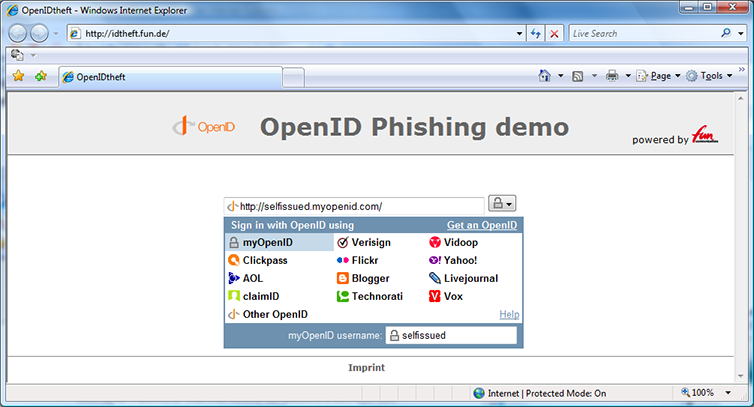
Figure 1: idtheft start

Figure 1: About to mount my attack against my OpenID at myopenid.com. I’ve typed the URL of my OpenID into the relying party.
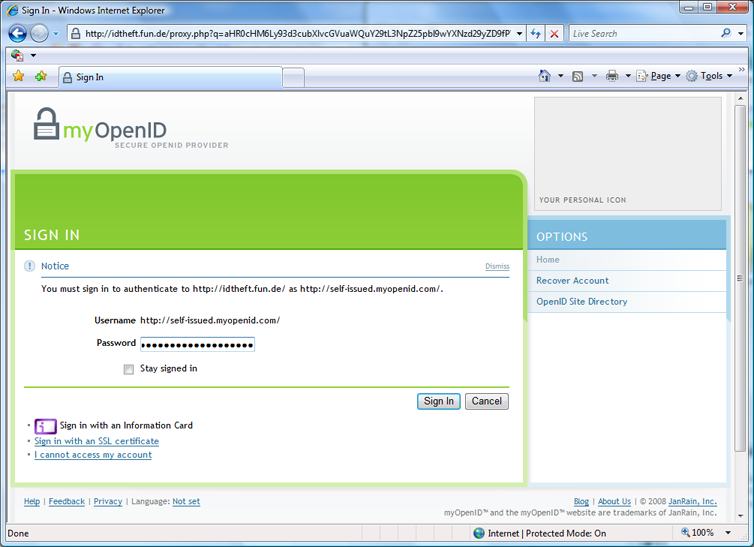
Figure 2: idtheft signin

Figure 2: Next, I’m logging in with a password. An observant user could notice several things wrong: the address bar shows the imposter’s URL, the imposter’s URL is present in the “You must sign in to authenticate to …” message, and the “Your Personal Icon” space is blank. Unfortunately, there is strong evidence that users are not observant.
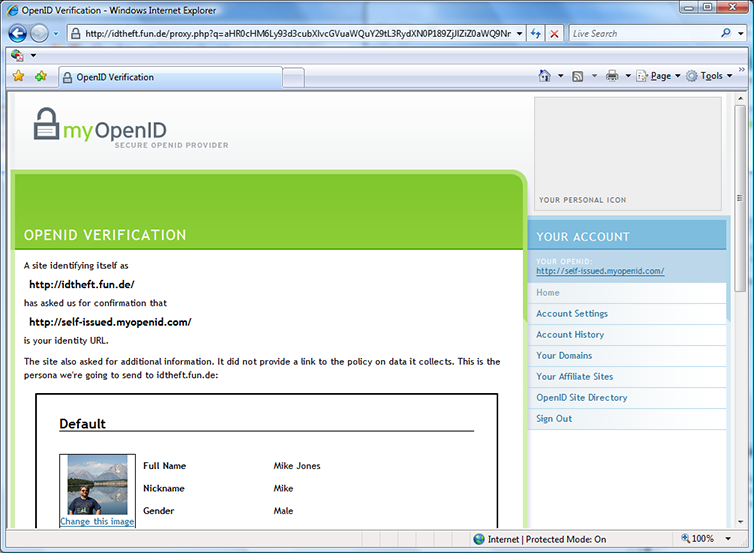
Figure 3: idtheft allow

Figure 3: Phishing already accomplished. Same cues are present that something’s amiss. Of course, a more sophisticated attack could replace the imposter’s URL in the page with the “real one” in both of these screens, eliminating the most obvious cue. I scroll down and click “Allow Once”.
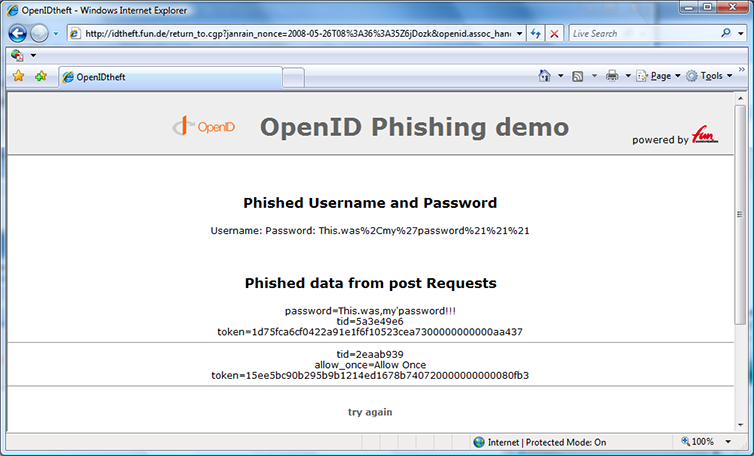
Figure 4: idtheft accomplished

Figure 4: Result after being redirected back to the “relying party”. Yes, that was my real password.

Next, I tried to attack my account again but was surprised that I wasn’t asked to log in this time. Of course — the attacker’s session was already logged in! So I signed out as the man-in-the-middle (that was weird), enabling me to try again.

My next steps looked just like Figures 1 and 2, except instead of typing a password I clicked the purple Information Card button. This brought me to:
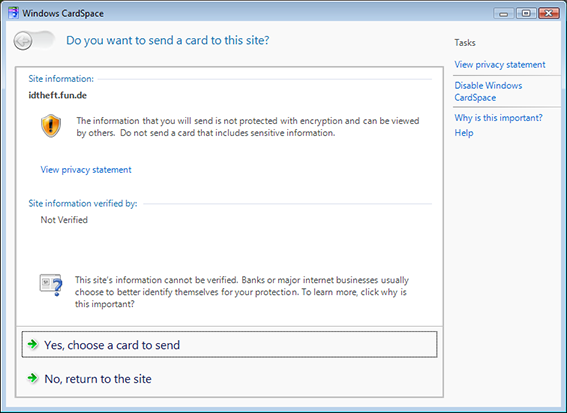
Figure 5: idtheft cardspace

Figure 5: CardSpace informs me that I’ve never sent a card to this site before. An observant user would realize that they don’t normally see this screen and might decline. But then, we’ve already discussed how observant users aren’t. I click “Yes”, choose the card I normally use to log into myopenid.com, and send it.
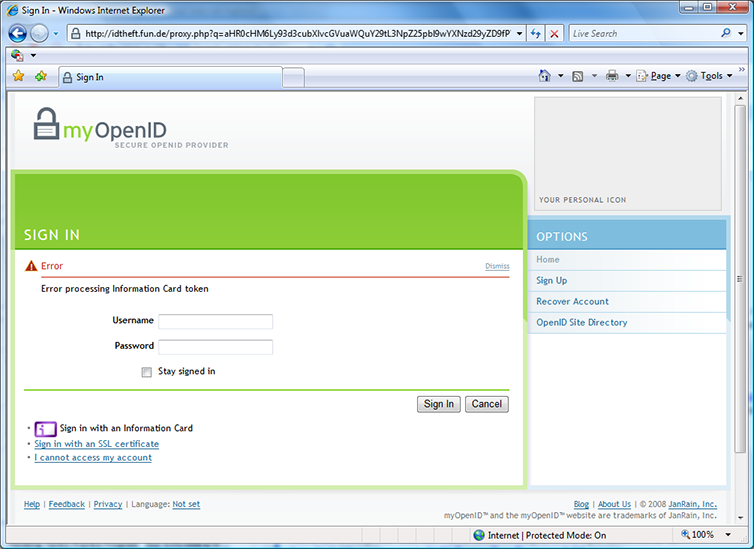
Figure 6: idtheft prevented

Figure 6: Phishing prevented. “Error processing Information Card token” isn’t the most informative error message I’ve ever seen but behind it is great news: the phishing attack failed because the token constructed for the imposter site wasn’t usable at the real site.

And thanks to idtheft.fun.de, you can try this at home!

Fun Communication’s Fun Identity Innovations

Fun Communications logoJohannes Feulner of Fun Communications recently showed me three different identity sites they’ve created, each fun and valuable in its own way. The first, www.webcard-loyalty.com, lets companies create online loyalty cards for their customers. These loyalty Information Cards enable merchants to offer bonuses and discounts when the cards are used, similarly to how physical loyalty cards such as frequent flyer cards and frequent shopper cards are used to provide these benefits in the offline world. You can read more about “virtual loyalty cards” and about the innovation prize they won.

The second, openidbycard.com, dynamically creates a site-specific OpenID to use at an OpenID relying party from any Information Card offering the privatepersonalidentifier (PPID) claim. Type “openidbycard.com” as your OpenID identifier into any OpenID login form and an OpenID will be created for the site based on the site identity and the PPID returned by the card. While I understand value of using public identifiers (such as self-issued.info) in some contexts, it’s great to also have the choice of using unidirectional identifiers at OpenID sites.

Finally, idtheft.fun.de demonstrates the ability of attackers to mount man-in-the-middle attacks against OpenID sites (and lets you try it yourself!). The site phishes OpenID passwords and other information sent through the browser, all via web pages that look authentic, but that are actually under control of the attacker. This will be the subject of my next post.

IBM Product Release for Information Cards and OpenID

IBM logoAs reported in InternetNews (and brought to my attention by Tony Nadalin), IBM has expanded the scope of its Tivoli Federated Identity Manager product to include support for Information Cards and OpenID. This is a fantastic development, as it puts software enabling use of these user-centric identity technologies into the hands of IBM’s numerous important customers, ranging from enterprises to Internet businesses. Congratulations to IBM and the Tivoli team for this significant achievement!

User-Centric Identity Interop at RSA in San Francisco

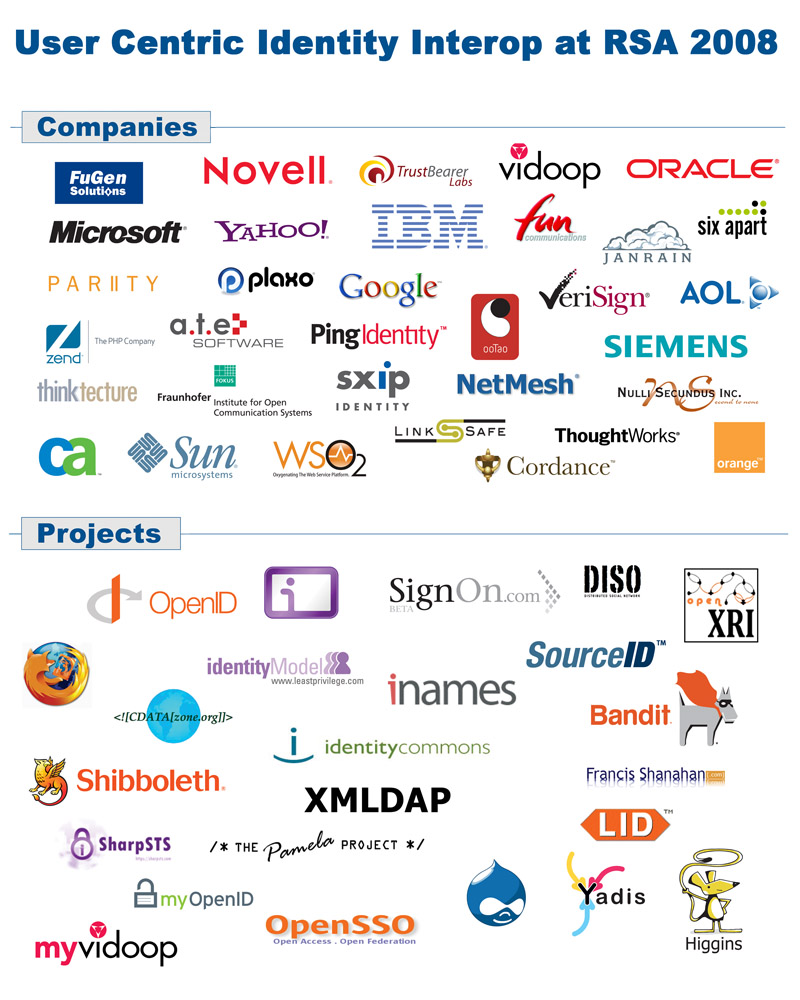
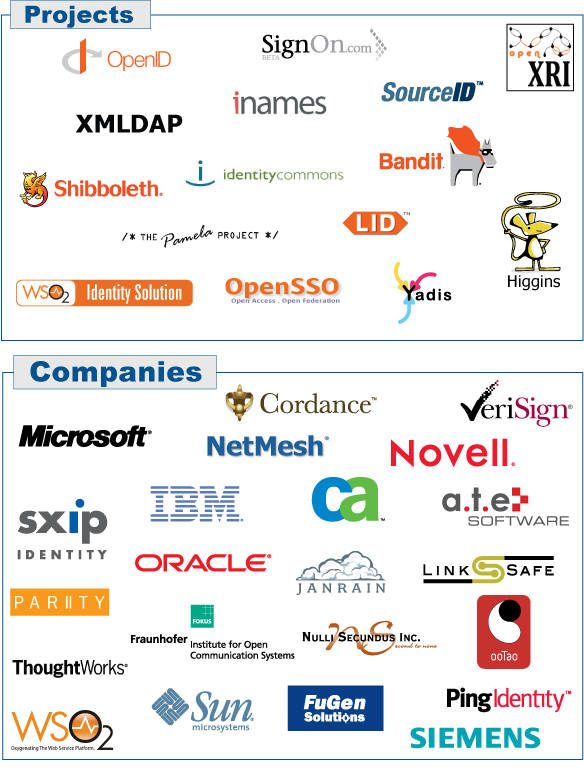
33 Companies…
24 Projects…
57 Participants working together to build an interoperable user-centric identity layer for the Internet!

Come join us!

Tuesday and Wednesday, April 8 and 9 at RSA 2008, Moscone Center, San Francisco, California
Location: Mezzanine Level Room 220
Interactive Working Sessions: Tuesday and Wednesday, 11am – 4pm
Demonstrations: Tuesday and Wednesday, 4pm – 6pm
Reception: Wednesday, 4pm – 6pm

Logos of RSA 2008 Interop Participants

Interops in Progress

OSIS logoTwo important identity interoperability demonstrations will occur at RSA two weeks from now: the OSIS User-Centric Identity Interop and the Concordia Multi-Protocol Federation Interop. During both you’ll see different projects and vendors publicly showing their identity software working together. But what you won’t see at the conference is what’s happening right now — the engineers behind these implementations working together to refine their deployments and their software to ensure that solutions that should work together in theory actually do in practice.

Like the previous OSIS Interop, the current one is testing both Information Card and OpenID implementations — sometimes in combination. I’m especially excited about this Interop for three reasons. First, the set of participants has expanded again by over 50% and includes many commercial deployments of these relatively new technologies. Second, much deeper testing is occurring than ever before. Thanks, in part, to significant efforts by Pamela Dingle and the Microsoft Identity Lab team, during this Interop not only are people trying their implementations with one another’s — they’re also systematically testing their support for an important range of protocol features using interop endpoints designed and deployed for this very purpose. Third, this Interop won’t end when the conference ends. Most of the participants plan to leave their endpoints up after the conference is over, enabling new participants to join and test later and for existing participants to re-test their implementations against the others when they deploy new versions. Visit the OSIS Interop demonstrations in person if you can, especially between 4:00-6:00 on both Tuesday and Wednesday during the conference.

Concordia logoThe Concordia Interop is showing the use of Information Cards to sign into both SAML 2.0 and WS-Federation based federations. Both these federations are using SAML 2.0 tokens carrying consistent authentication context information. (I believe that this is the first public demonstration of WS-Federation implementations using SAML 2.0 tokens.) Furthermore, the Concordia Interop demonstrates the ability to bridge between WS-Federation and SAML federations, allowing identities originating in one to be used to authenticate to services in the other. Visit the Concordia workshop during the conference on Monday from 9:00-12:30.

Finally, I’m not the only one excited by these Interops. Axel Nennker, Francis Shanahan, Gerald Beuchelt, Prabath Siriwardena, Scott Kveton, Vittorio Bertocci, and Will Norris have all written about the upcoming OSIS Interop. There’s also a press release from the Concordia project. Hope to see many of you at RSA!

Re: OpenID kills Windows CardSpace?!

The thing that immediately came to mind when I read the subject of Christian’s post was Mark Twain’s famous remark, upon learning about rumors of his own demise: “The report of my death is an exaggeration”.

Apparently the German press hasn’t been following my blog (I’m hurt but not totally shocked :-)) or Kim’s or JanRain’s or VeriSign’s or Ping Identity’s or Andy’s or Dick’s or David’s or Drummond’s or Scott’s or Paul’s or so many others where we’re all talking about the valuable ways that Information Cards and OpenID work well together. And there’s more than just talk. For instance, the OpenID providers LinkSafe.name, MyOpenID.com, PIP.VeriSignLabs.com, and SignOn.com all enable account creation and login with Information Cards. Is this good for OpenID? Yes! Is it good for CardSpace (and other Identity Selectors)? Yes!

But lest anyone has the perception that Microsoft’s participation in OpenID somehow lessened our commitment to CardSpace, I’ll respond plainly: That is simply not true. I work in the corridors where the CardSpace team is actively building the next version (which incorporates lots of the great feedback we’ve received from users and partners on our present versions) and down the hall from where our server product is being built that will make it easy to issue and accept Information Cards. I can honestly report that both teams are excited, executing on their mission, and moving full speed ahead!

In answer to Christian’s question “Why didn’t Microsoft explain the whole picture in the moment of releasing such news?”, I’ll respond pointing out that the news of February 7th was about Microsoft and others joining the OpenID Foundation board — not about CardSpace, and we were comfortable with that. We are confident enough of the value that CardSpace brings to the table to also openly embrace other identity technologies where they make sense, without feeling that the existence of one diminishes the other. We are confident that others (including many of the leaders in the OpenID community) share this view.

So to our great partners like Christian who are out there rocking, building innovative identity solutions that are part of the “Identity Big Bang” with Information Cards and CardSpace I say this: Congratulations on your fantastic work! We’re fully behind you!

And to our great partners who are also helping create the “Identity Big Bang” by employing OpenID where it makes sense: We salute you too!

The Internet Identity Layer is still very much a work in progress. I’m thrilled to be part of making it happen and to be in a community that is collaborating and building upon one another’s work. And if I were on the outside watching, I certainly wouldn’t be holding my breath wondering if one of these identity technologies is going to “kill” the other one — especially when the truth is that they’re both stronger because of the other.

Information Cards, i-names, OpenID, Ruby, and Interop!

ooTao logoMy congratulations to ooTao and LinkSafe for enabling account creation and login at LinkSafe’s i-broker using Information Cards. Building on what I wrote earlier about I-names without Passwords at LinkSafe, Andy Dale recently wrote:

Working together Microsoft, LinkSafe and ooTao have developed the first Info-Card enabled i-broker. You can register for an i-name at LinkSafe and subsequently log in to any OpenID 2.0 relying party without ever entering a password. All of the security can be Info-Card driven.

We have made the Ruby RP Module deployed at LinkSafe available under BSD license along with a simple ‘hello world’ app that demonstrates driving the module.

inames logoSee Andy’s post for instructions on where to get the software and for a demo site where you can try it out.

And as long as I’m on the topic of trying out software, I thought I’d mention that the latest OSIS User-Centric Identity Interop is under way! Visit the new OSIS page and browse through the Interop Participants, the Software Solutions, and the Cross Solution Results. There’s more to come, including more participants (contact me if you’re interested!) and feature-specific tests, but I wanted to let people know that we’re out there testing our software together now, including both Information Card and OpenID implementations, with Interop demonstrations to occur at the RSA Conference in April. And of course, ooTao and LinkSafe are participating!

Microsoft Joins the OpenID Foundation and its Board of Directors

OpenID logoToday the OpenID Foundation announced that five leading technology companies, Google, IBM, Microsoft, VeriSign, and Yahoo! have joined the OpenID board of directors as its first corporate board members. This news comes a year and a day after the JanRain/Sxip Identity/Microsoft/VeriSign OpenID/CardSpace collaboration announcement introduced by Bill Gates and Craig Mundie at the RSA Security Conference.

How are these events related, you might ask? As I see it, they’re both great examples of the industry working together to solve the digital identity problems that all Internet users presently face — in these cases, both in the context of OpenID.

A lot’s happened over that year-and-a-day that’s worth celebrating:

From a personal perspective, I’ve enjoyed working with colleagues from numerous companies (including from my own!) to help get us to today’s announcement, as well as working to bring safer, easier-to-user login and account creation to OpenIDs via Information Cards. Thus, I’m both pleased and honored to now be representing Microsoft on the OpenID Foundation board of directors.

Of course, today’s announcement is really only the end of the beginning. The real fun and value is still ahead of us, in the work we’ll do together. The draft PAPE specification needs to be completed. We need to drive relying party adoption of phishing-resistant authentication. And talk of an OpenID 3.0 that’s both easier and safer to use is already percolating on the mailing lists.

The Internet is still missing a much-needed ubiquitous identity layer. The good news is that the broad industry collaboration that has emerged around OpenID is a key enabler for building it together!

New Years Gift: OpenID Intellectual Property Policy Approved

OpenID logoAs Scott Kveton just posted, earlier this month the OpenID Foundation board approved OpenID Intellectual Property Policy and Procedures documents. These are designed to achieve two goals:

  • Ensuring that contributors to OpenID specifications make intellectual property declarations for relevant inventions that they own so that everyone can freely use those specifications.
  • Defining procedures for working groups to use when developing future OpenID specifications that enable all to participate.

In addition to those Scott thanked, I’d also like to extend sincere thanks to Ron Moore of Microsoft and David Daggett of K&L Gates, both of whose legal expertise was essential to this accomplishment.

This is a significant digital identity accomplishment to finish 2007 with. Happy New Years everyone!

I-names without Passwords at LinkSafe

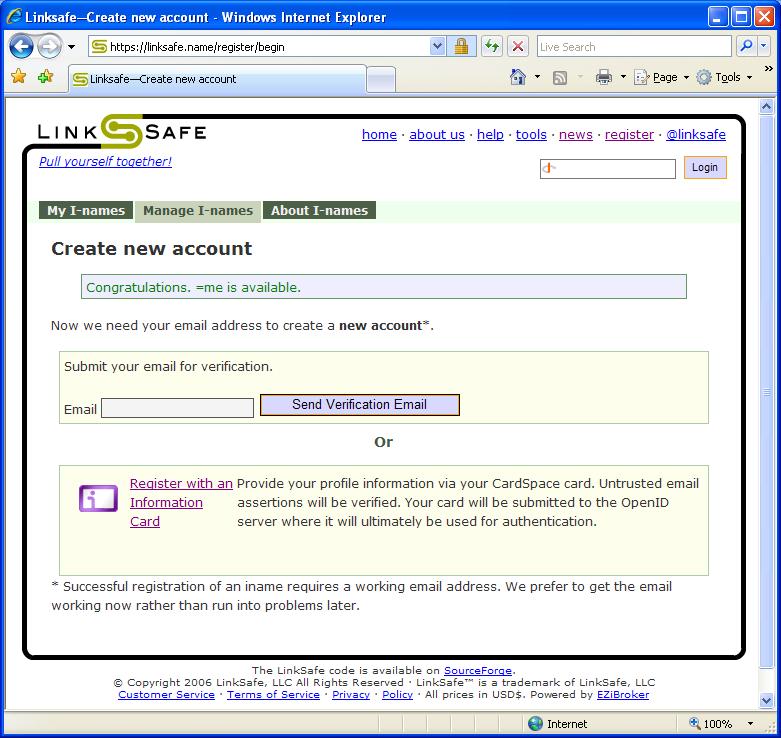
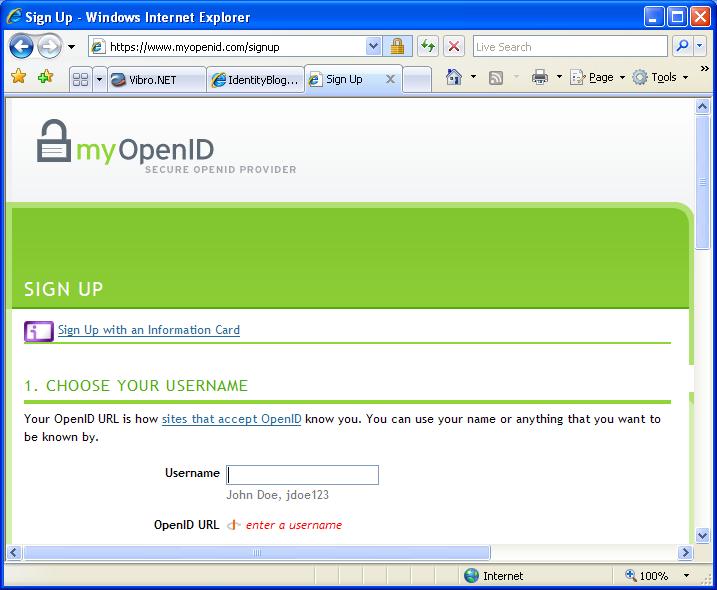
I’m pleased to report that ooTao and LinkSafe have recently collaborated to enable you to create and use i-names with Information Cards rather than passwords. They’ve achieved for LinkSafe.name what JanRain did for MyOpenID.com. Below is a screen shot of me signing up for an i-name using an Information Card, rather than a password. Now when you see someone signed in to a site with the OpenID =me, you’ll know who it actually is!

LinkSafe.name i-name signup with Information Card

OpenID 2.0 Specifications Complete

This morning at the Internet Identity Workshop, the OpenID Foundation announced that the OpenID 2.0 Specification and a set of related specifications are now complete. Furthermore, Intellectual Property Contribution Agreements have been executed by all the contributors to these specifications.

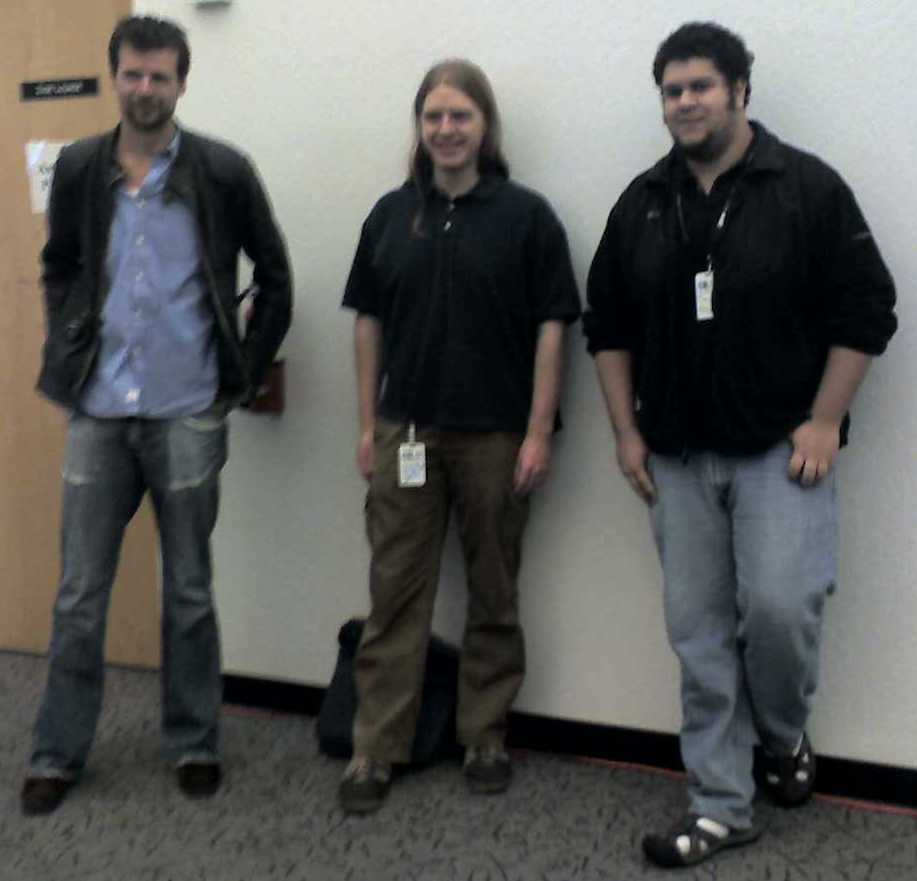
Here’s a camera-phone photo of Dick Hardt of Sxip Identity, Josh Hoyt of JanRain, and David Recordon of Six Apart making the announcement. Congratulations to the OpenID community on this significant accomplishment!

Dick Hardt, Josh Hoyt, and David Recordon announcing that the OpenID 2.0 specifications are complete

Look ma! No passwords!

As Vittorio excitedly pointed out, you never have to enter a password to create or use an OpenID at MyOpenID.com. Kim’s excited about this too. So am I. When I wrote:

The JanRain team has done a fantastic job integrating account sign-up, sign-in, and recovery via Information Cards into their OpenID provider. I’m really impressed by how well this fits into the rest of their high-quality offering.

I should have expanded upon my point “fantastic job integrating account sign-up” to explicitly call out that no passwords are needed. Notice the Information Card button on the sign-up page below. Thanks Vittorio and Kim, for sharing your excitement about this. I’m hoping that as other sites integrate Information Card sign-in to their user experience that they’ll also follow this example (and the guidance in the deployment guide) and enable password-less sign-up with Information Cards.

MyOpenID.com signup with Information Card

Related to this is JanRain’s earlier announcement that they are including PAPE support in their widely-used OpenID relying party libraries. As Kevin Fox wrote:

Just a note to let everyone know that we are developing and will release relying party libraries supporting PAPE once the specification is finalized.
We have deployed an example relying party available here:
openidenabled.com/python-openid/trunk/examples/consumer/
The example fully supports OpenID 2.0 draft 12, and can request phishing-resistant authentication using PAPE. Feel free to use it for testing.
PAPE allows sites that use OpenID 2.0 authentication to get information about the way that the user authenticated to the provider. This is an important step on the way to getting the convenience needed of OpenID authentication for higher-valued transactions. It’s trivial to implement and will be included in JanRain’s OpenID 2.0 libraries as well as Sxip’s libraries.

Gary Krall also added that:

Verisign will also be releasing an update to the JOID library which we use on the PiP for as you may know we have added PAPE support to the PiP.

And I’ll add that MyOpenID.com and SignOn.com both also support PAPE on their OpenID providers.

Why is this exciting? Because it means that without use of without any use of passwords, people can create and use OpenIDs with their Information Cards. And that sites accepting OpenIDs can ask for phishing-resistant authentication when you sign in — which these OpenIDs will do for you. All more great steps towards building a convenient, secure, ubiquitous identity layer for the Internet!

User-Centric Identity Interop at Catalyst in Barcelona

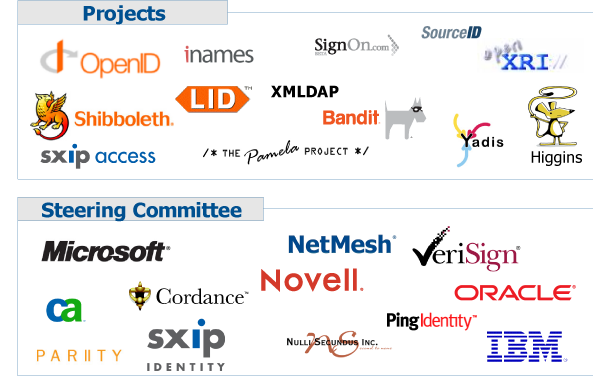
Logos of Barcelona Interop Participants 2007

Last night OSIS and the Burton Group held the third in a series of user-centric identity Interop events where companies and projects building user-centric identity software components came together and tested the interoperation of their software together. Following on the Interops at IIW in May and Catalyst in June, the participants continued their joint work of ensuring that the identity software we’re all building works great together.

This Interop had a broader scope along several dimensions than the previous ones:

An excerpt from Bob Blakley’s insightful-as-always commentary on the Interop is:

The participants have posted their results on the wiki, and a few words are in order about these results. The first thing you’ll notice is that there are a significant number of “failure” and “issue” results. This is very good news for two reasons.

The first reason it’s good news is that it means enough new test cases were designed for this interop to uncover new problems. What you don’t see in the matrix is that when testing began, there were even more failures — which means that a lot of the new issues identified during the exercise have already been fixed.

The second reason the “failure” and “issue” results are good news is that they’re outnumbered by the successes. When you consider that the things tested in Barcelona were all identified as problems at the previous interop, you’ll get an idea of how much work has been done by the OSIS community in only 4 months to improve interoperability and agree on standards of component behavior.

Be sure to read his full post for more details on what the participants accomplished together. And of course, this isn’t the end of the story. An even wider and deeper Interop event is planned for the RSA Conference in April 2008. Great progress on building the Internet identity layer together!

MyOpenID adds Information Card Support

JanRain logoKevin Fox just announced that JanRain has added Information Card support to MyOpenID.com. As he wrote:

The JanRain OpenID team is pleased to announce Information Card support has been added to MyOpenID.com.

What is an Information Card?

What can I do with it? With a self-issued Information Card you can sign-in to MyOpenID, as well as sign-up and recover your account, without ever having to enter your password. Anywhere on MyOpenID that you can enter a password will now allow you to use an Information Card instead. With the addition of Information Card support MyOpenID is able to offer another solid option for people wanting to protect their OpenID account from phishing attacks and remember fewer passwords.

We were able to work with Microsoft’s Mike Jones and Kim Cameron who have both been long time proponents of OpenID + Information Card support.

As noted by Kim Cameron “Cardspace is used at the identity provider to keep credentials from being stolen. So the best aspects of OpenID are retained.” While one of the less desirable aspects (confusing user experience) has been improved for someone using an Information Card to login to their OpenID provider.

Support for Information Cards has been growing as more software projects implement the technology. It is important to note that this technology is being supported by many other organizations besides Microsoft. Information Card support is available for Windows platforms (Vista / XP) as well as Mac OS X and Linux.

The JanRain team has done a fantastic job integrating account sign-up, sign-in, and recovery via Information Cards into their OpenID provider. I’m really impressed by how well this fits into the rest of their high-quality offering.

There’s another kind of integration they also did that makes this even more impressive in my mind: connecting their new Information Card support with their existing support for the draft OpenID phishing-resistant authentication specification. This is another significant step in fulfilling the promise of the JanRain/Microsoft/Sxip Identity/VeriSign OpenID/Windows CardSpace collaboration announcement introduced by Bill Gates and Craig Mundie at the RSA Security Conference this year. Because of this work, this sequence is now possible:

  1. A person goes to an OpenID relying party and uses an OpenID from MyOpenID.com.
  2. The OpenID relying party requests that MyOpenID.com use a phishing-resistant authentication method to sign the user in.
  3. The person signs into his MyOpenID.com OpenID with an Information Card.
  4. MyOpenID.com informs the relying party that the user utilized a phishing-resistant authentication method.

This means that MyOpenID users will be able to get both the convenience and anti-phishing benefits of Information Cards at OpenID-enabled sites they visit and those sites can have higher confidence that the user is in control of the OpenID used at the site. That’s truly useful identity convergence if you ask me!

The Popularity of OpenID and How It Relates To “Home Realm Discovery”

Andy Dale recently made a great post titled “Adopting Evolution” in which he asked the question:

Why has OpenID grabbed so much popularity while SAML, a much more mature, academically respected, ‘robust’ specification has been largely ignored by the cutting edge web 2.0 community?

I’ll encourage you to read his post for his insightful answer.

His question reminded me of another answer to the same question that I gave during the recent Concordia meeting at DIDW: OpenID solves the “Home Realm Discovery” problem that all Federation protocols face; that is, figuring out where the person’s authentication information should come from.

There’s lots of ways this problem can be solved, many of which involve potential identity providers being pre-configured by system administrators as possible choices for specific services. Some systems have even dictated the use of a particular identity provider. OpenID’s solution to this is elegant in its simplicity: Let the user decide. When I type in an OpenID URL such as https://mbj.signon.com/ I’m telling the relying party where my identity provider for this interaction is — thus solving the “Home Realm Discovery” problem. As elegant as this is, of course, the potential downside of this solution is that it assumes that people will remember their OpenID identifiers and will faithfully type them in when a page prompts them for an OpenID.

OpenID 2.0 actually allows i-names such as =mbj or =Mike.Jones to be used as OpenIDs as well. I-names then use their own lookup protocol to discover the identity provider behind the i-name typed. This is arguably better (and is the kind of OpenID I personally use), but still relies on the user to reliably enter their OpenID identifier when prompted.

In this discussion at Concordia, others pointed out that using an Identity Selector (such as DigitalMe or CardSpace) is another means of solving the problem. Like OpenID, it also lets the user decide, but in this case, by clicking on a visual Information Card, rather than typing in a string. I personally believe that this will be an easier metaphor for many people to use once it’s commonly available than typing in an OpenID identifier.

I’ll also point out that it’s not a one-or-the-other choice between OpenIDs and Information Cards when letting the user decide. As was recently demonstrated, OpenID Information Cards can be used to deliver the OpenID identifier to the OpenID relying party, rather than having the user type it.

In conclusion, while it may seem esoteric, solving the “Home Realm Discovery” problem is essential to working digital identity deployments. And the usability of the solution chosen matters a lot. Using Andy’s terminology, I believe that its solution to this problem both accounts for some of “the juju that OpenID has” and may result in usability problems for less technical audiences that will need to be addressed if it’s to break out beyond just us geeks.

Information Cards for OpenIDs

Sxip Identity just finished a draft specification that enables a really useful form of convergence between OpenIDs and Information Cards: presenting your OpenID as an Information Card you select rather than as a string you type. Johnny Bufu’s OpenID general mailing list note introduces this specification for community review.

This combination has several advantages over standard OpenID usage. First, there’s no OpenID string to type when you use your OpenID, which should make OpenIDs easier for more people to use. Second, this is a phishing-resistant authentication method. Finally, it lets you recognize and choose your OpenID visually, based on the card graphics supplied by the OpenID provider.

Sxip also backed this specification by a sample implementation, which you can check out at https://openidcards.sxip.com/. Now for some more details….

Here’s how it works: In this model, the OpenID relying party asks for an OpenID Information Card using an object tag on the page rather than having the user type the OpenID as a string (while probably also giving the user the option to instead type in the string for backwards compatibility). The user’s Identity Selector then lets the user choose which OpenID card to send to the site. The card transmits the actual OpenID string to the site as a claim. From that point on, standard OpenID protocol interactions ensue.

For instance, the sample relying party page asks you to “Login with an OpenID InfoCard” and requests the card using this evocative graphic:

OpenID InfoCard

Upon clicking the graphic, my identity selector is invoked, which shows me that I can use this OpenID Information Card at the site (which I’d previously obtained here):

Sxip OpenID InfoCard

After that, the sample performed a standard OpenID attribute exchange and the relying party greeted me with:

Welcome! You have logged in using your https://openidcards.sxip.com/i/mbj OpenID identifier.

Phone: (omitted)
Country: USA
Email: mbj@microsoft.com
City: Redmond
Address: One Microsoft Way, Building 40/5138
LastName: Jones
FirstName: Mike

Behind the scenes, the relying party had received this OpenID assertion:

<openid:OpenIDToken xmlns:openid="http://specs.openid.net/auth/2.0">openid.ns:http://specs.openid.net/auth/2.0
openid.op_endpoint:https://openidcards.sxip.com/op/
openid.claimed_id:https://openidcards.sxip.com/i/mbj
openid.response_nonce:2007-08-26T20:55:34Z0
openid.mode:id_res
openid.identity:https://openidcards.sxip.com/i/mbj
openid.return_to:https://openidcards.sxip.com/demorp/
openid.assoc_handle:f27d249fc4108198
openid.signed:op_endpoint,claimed_id,identity,return_to,response_nonce,assoc_handle
openid.sig:gKKpDjEbgByJo48Q800Jq4gCJng=
openid.ns.ext1:http://openid.net/srv/ax/1.0-draft4
openid.ext1.mode:fetch_response
openid.ext1.type.attr1:http://axschema.org/contact/phone/default
openid.ext1.value.attr1:(omitted)
openid.ext1.type.attr2:http://axschema.org/contact/country/home
openid.ext1.value.attr2:USA
openid.ext1.type.attr3:http://axschema.org/contact/email
openid.ext1.value.attr3:mbj@microsoft.com
openid.ext1.type.attr4:http://axschema.org/contact/city/home
openid.ext1.value.attr4:Redmond
openid.ext1.type.attr5:http://axschema.org/contact/postalAddress/home
openid.ext1.value.attr5:One Microsoft Way, Building 40/5138
openid.ext1.type.attr6:http://axschema.org/namePerson/last
openid.ext1.value.attr6:Jones
openid.ext1.type.attr7:http://axschema.org/namePerson/first
openid.ext1.value.attr7:Mike
</openid:OpenIDToken>

One final technical note that will be of interest to some of you: OpenID Information Cards do not use SAML tokens. They use one of two variants of openid:OpenIDToken tokens (depending upon whether the OpenID relying party uses OpenID 1.1 or 2.0 authentication).

Go get yourself an OpenID Information Card and give it a spin! Read and comment on the spec. Or even better yet, implement it and tell us about your experience!

User-Centric Identity Interop at Catalyst

OSIS Logos

I’ve been waiting to write about the user-centric identity interop at the Burton Group Catalyst conference until the Burton Group report about the event was published. Now it’s here!

At the interop we demonstrated interoperability between 7 Identity Selectors, 11 Identity Providers, and 25 Relying Parties. As Bob Blakley wrote:

The interop event was a milestone in the maturation of user-centric identity technology. Prior to the event, there were some specifications, one commercial product, and a number of open-source projects. After the event, it can accurately be said that there is a running identity metasystem.

The full report includes a list of participants and the software they brought to the table, an overview of the results achieved, as well as the issues identified through the interop. See Bob’s post for all the details!

The report also includes thank-yous, to which I’d like to make some additions: Thanks are due to Jamie Lewis, Gerry Gebel, and Bob Blakley of the Burton Group for sharing our vision for this interop, striving to make it the best that it could be, and tirelessly working the details until it came true. You truly helped the industry to come together in a valuable and significant way.

Also, while I appreciate Bob’s thanks for the work I put into the Open Specification Promise, there were many believers in and drivers of this important work at Microsoft besides myself, both from the Law and Corporate Affairs team and from the Federated Identity product group. This was truly a team effort.

I’m also happy to report that there will be a follow-on interop in Europe at the Catalyst conference in Barcelona, October 22-25, which will hopefully include even more participants and scenarios, including more multi-protocol interoperation proof points. Hope to see you there!

Information Cards at OpenID Providers

PIP InfoCardsThis week VeriSign upgraded their Personal Identity Provider (PIP) to support Information Cards. As David Recordon wrote at VeriSign’s official “Infrablog”:

Last Saturday, we completed the upgrade of our Personal Identity Provider. All accounts have been automatically upgraded and the URL is the same at http://pip.verisignlabs.com. We definitely encourage everyone to come try it out as we believe it is the best OpenID Provider in existence! Not only does it have all of the features from the PIP we launched last May, but adds support for OpenID 2.0, the ability to manage multiple identities within one PIP account, integration with strong authentication via our VeriSign Identity Protection network, Information Card support as one way to help protect against phishing attacks, and our SeatBelt Firefox add-on which works with a variety of OpenID Providers.

PIP supports Information Cards in two ways:

  • Logging into your PIP account: You can use a managed Information Card to log into your PIP account, providing a phishing-resistant alternative to logging in with a username and password typed into the browser.
  • Using your PIP Identities at other sites: PIP issues managed Information Cards for each of your PIP identities, which you can use to sign into sites using Information Cards for login and/or account creation. (And of course, these same identities are also OpenIDs as well.)

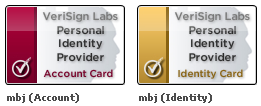
Images of my PIP cards for these two use cases are shown at the top of this post. I can now use my PIP account card to sign into my PIP account and my PIP identity card to sign into other sites. PIP is doubly cool because I believe it’s also the first general-purpose identity provider to be secured by an Extended Validation Certificate (see the green color of the IE7 address bar?). Great progress!

SignOn.com LogoThis follows on last month’s launch of Ping Identity’s SignOn.com identity provider. SignOn.com lets you log into your OpenID account using a self-issued Information Card — a convenient, password-free, and phishing-resistant authentication mechanism.

Both are fantastic steps towards our shared goal of building a convenient, secure, ubiquitous identity layer for the Internet. Expect to see lots more developments like this soon!

Yours truly,
mbj.pip.verisignlabs.com and mbj.signon.com

Page 11 of 12

Powered by WordPress & Theme by Anders Norén